.png)
Course Practicum
Exploring computer programming through algorithms, data management, and program development based on Visual Basic and Java.
COMPUTER PROGRAMMING
Algorithm of Programming
Spreadsheet Data Analysis
Visual Basic
Database Management
Fundamentals of Java Programming
Python for Data Science
.png)
About Program
Computer Programming
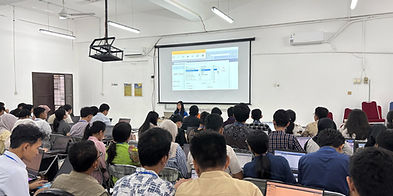
Computer Programming Course Practicum was designed for undergraduate students of Industrial Engineering Program Study, Faculty of Engineering, University of Sumatera Utara in order to improve practical skills. The material is adjusted to the theories in the course and can be revised in accordance with the consideration of the progress of science and technology. Course Practicum material uses Raptor, Microsoft Visio, Microsoft Excel, Python, Microsoft Access, Microsoft Visual Basic and Java.

Project Tools
About Modules
Course Modules
What will you learn during this course project?
Module I
Module II
Module III
Module IV
Module V
Module VI
ALGORITHM OF PROGRAMMING
Module I
Programming Algorithms focuses on understanding the basics of developing logical steps to solve problems using computers. Participants will learn to design efficient and systematic algorithms before translating them into program code, enabling them to understand programming logic and build a strong foundation in effective and accurate program development.

Software


SPREADSHEET DATA ANALYSIS
Module II
Spreadsheet Data Analysis focuses on data processing and analysis using Microsoft Excel as the main tool. Participants will learn how to use formulas, functions, Pivot Tables, and Chart Tools to perform automatic calculations, statistical analysis, and interactive data visualization. Through this module, participants are expected to be able to manage and analyze quantitative data effectively and efficiently to support decision-making, including in financial and managerial contexts.

Software

VISUAL BASIC
Module III
Visual Basic covers the concepts and application of visual-based programming using Microsoft Visual Basic as an application development tool. Through this module, students will understand the use of the development environment, interface components, and Visual Basic features in building desktop-based applications.
This module also emphasizes the application of programming logic and structure, as well as application integration with online databases using Supabase for dynamic data management. Thus, the Visual Basic module provides an important foundation for developing structured, interactive applications that are connected to modern database systems.

Software


DATABASE MANAGEMENT
Module IV
Database Management discusses concepts and applications in data management using database management systems (DBMS) such as MySQL, Microsoft Access, or PostgreSQL. Through this module, participants will understand how to organize, store, and manage data in a structured manner in interconnected relational tables, as well as the importance of primary keys and foreign keys in maintaining data integrity. This module also emphasizes the role of DBMS in supporting efficiency, security, and data consistency, which are the main foundations of modern information systems in various fields.

Software
FUNDAMENTALS OF JAVA PROGRAMMING
Module V
Fundamentals of Java Programming introduces the basic concepts of programming using the Java language, known for its “write once, run anywhere” principle. In this module, participants will learn the basics of Object-Oriented Programming (OOP) such as classes, objects, inheritance, and polymorphism to build modular and efficient systems. Java is widely used for developing desktop, mobile, and web applications, so understanding its fundamentals is an important foundation for students in building robust, structured, and easily developed applications.

Software


PYTHON FOR DATA SCIENCE
Module VI
Python for Data Science focuses on the application of the Python programming language for data analysis and interpretation. Participants will learn important stages in data science such as data cleaning, exploration, modeling, and visualization by utilizing popular libraries such as NumPy, Pandas, Matplotlib, and Scikit-Learn. With its simple and flexible syntax, Python has become the primary tool for data-driven decision making in various fields, ranging from business and industry to academic research.

Software


Course Practicum Materials
Module
Badgename
List Probihited Python
Attribute
Statement Letter
Gantt Chart
